Casualties: Unknown simulates the body in layers: each limb has skin health, muscle health, bleeding, infection, bone state and pain, and the whole body has blood volume, pressure, oxygen, heart rhythm, temperature and brain health. Most deaths start small. A cut that was never bandaged gets infected, the fever drains water, low blood volume drops pressure, and the heart begins to fibrillate. Treat early and treat the cause.
Triage panel: pick a body part
Tap a body part or a region button to filter. Each file lists the signs, the fix in order and the items to carry. Conditions are sorted from critical to minor.
UNI-TRIAGE v1.020 files
Tap a body part, then open a symptom file.
Internal bleeding Critical
Signs: Blood volume drops but no limb shows a teardrop. Internal bleeding moodle from about 0.043 L/min. Coughing or vomiting blood.
- Use an L.R.D. or makeshift L.R.D., inject procoagulant, or eat helluce.
- Do not thin your blood: low viscosity makes every bleed faster.
- Watch for hemothorax and drain it.
- Makeshift L.R.D. (INT 10)
- L.R.D. serum (INT 11)
- L.R.D. (INT 15)
- Procoagulant
- Helluce (layer 4+)
Hemothorax Critical
Signs: Yellow outline growing around the lungs. Moodle at 40, critical at 70. Max oxygen and breathing rate fall.
- Stop the internal bleeding first, or it keeps refilling.
- Use a chest drain on the chest: -35 hemothorax per use. It recharges over time.
- Below the internal-bleeding threshold it also drains on its own, about 2 per minute.
- Chest drain (INT 12)
Sepsis Critical
Signs: Sepsis moodle once total infection across limbs passes 100. Low blood pressure, less stamina and oxygen.
- Bring total infection under 100: disinfect every infected limb or amputate the worst one.
- Antibiotics and antiserum slow it. At 196% immunity infections clear on their own.
- Antibiotics
- Antiserum
Fibrillation Critical
Signs: Heart rate climbing fast, ragged ECG, alarm above 60%, heartbeat audible outside the panel.
- Shock it: AED, or a manual defibrillator set to about 2x the fibrillation % in joules.
- Amiodarone lowers it. Touching a coil also resets it.
- Fix the cause or it returns: low blood pressure, low oxygen, high heart rate, thick blood, cold, too much epinephrine.
- AED
- Manual defibrillator
- Amiodarone
- Auto-pump
Cardiac arrest Critical
Signs: Flat ECG, heart rate 0, the screen fades with the dying drone.
- Put on an auto-pump if you have one: it keeps oxygen moving.
- Shock with a defibrillator: each successful shock has a 20% chance to restart the heart, any power works.
- Epinephrine can restart it too (with 50% fibrillation).
- Auto-pump
- AED / manual defibrillator
- Epinephrine
Stroke Critical
Signs: Stuttering speech, losing vision behind you, left arm getting weak, the health button flashing. The moodle only shows above 70.
- Braingrow (any amount) clears it over 100 seconds.
- Procoagulant reduces it fast. A neural booster or mindwipe resets it.
- Then lower blood pressure so it does not happen again.
- Braingrow
- Procoagulant
- Neural booster (INT 18)
Bleeding Serious
Signs: Teardrop icons on a limb, the Bleeding moodle, blood volume falling in the health panel.
- Drag a dressing onto the bleeding limb and finish the bandage minigame.
- Over about 1 L/min: tourniquet that limb first (never the head), then bandage, then take the tourniquet off.
- Refill blood: blood bag, Ringer's solution or saline. Stay fed: blood only regenerates with hunger above 0.
- Dressing (INT 7)
- Sterilized dressing
- Tourniquet (INT 9)
- Blood bag (INT 12)
Infection Serious
Signs: Cyst icon on a limb (shown from 25%), green then purple stripes on the body, rising temperature, limb pain.
- Disinfect the limb: sterilized dressing, relief cream or antiseptic from a spray bottle, or a glowplant fruit in a pinch.
- Raise immunity: eat, stay warm, antibiotics.
- Above 60% you can amputate with a blade to stop it spreading.
- Spray bottle (INT 7)
- Relief cream / Antiseptic (INT 9)
- Antibiotics
- Machete or cleaver for amputation
Fracture Serious
Signs: Broken-bone icon. A broken arm cannot hold items. A broken leg hurts on every jump and landing.
- A bone welding tool cuts the remaining heal time to a quarter: use it early.
- A splint speeds healing about 2.5x.
- Untreated, a fracture heals in about 39 minutes: stock food and water.
- Bone welding tool
- Splint
Blood pressure too low or high Serious
Signs: Hypotension moodles below 110/73, hypertension above 130/86. Dizzy, pale, nosebleed above 155/102.
- Low: restore blood volume, treat sepsis, warm up, cut back on opiates. Vasopressin raises it.
- High: stop overdrinking, cool down from cold, let thick blood settle. Sodium nitroprusside lowers it.
- Above 180 systolic there is a 2% chance per second of stroke.
- Blood bag
- Vasopressin
- Sodium nitroprusside
Brain damage Serious
Signs: Screen distortion, mirrored controls, random ragdolls, vomiting and garbled text, starting below 95% brain health.
- Braingrow repairs it, in small doses only: overdosing is dangerous.
- Otherwise it heals slowly, about 11% per hour.
- Prevent it: makeshift helmet, then bicycle or riot helmet. Keep oxygen up.
- Braingrow
- Makeshift helmet (INT 8)
- Bicycle helmet (INT 13)
- Riot helmet (INT 17)
Pain & shock Serious
Signs: Red vignette. Severe pain above 55, agony above 80. Pain shock above 66% knocks you out.
- Painkillers, morphine or fentanyl. Watch opiate overdose.
- An ice pack speeds pain recovery by 150% and never runs out.
- Treat the cause: dislocations, fractures and shrapnel hurt until fixed.
- Painkillers
- Morphine (INT 9)
- Fentanyl (INT 11)
- Ice pack
Unconscious / concussed Serious
Signs: Blurring and darkening below 70% consciousness. Below 30% you cannot act. Concussed when head muscle health drops under about 14%.
- Find the cap: oxygen, blood pressure, pain, energy, temperature or brain health each limit consciousness.
- Concussion lifts when the head heals: head muscle heals 10x faster while concussed.
- Stimulants raise consciousness short-term.
- Stimulants
- Bruise kit
Radiation sickness Serious
Signs: Radiation icon filling, rising sickness, blood loss above 3 Gy, random infections and brain hits above 9 Gy.
- Get away from spent fuel, waste barrels and toxirock.
- Take anti-rad (you can overdose).
- Check "clean water" closely: a radioactive variant exists.
- Anti-rad
- Geiger counter
Too cold / too hot Serious
Signs: Chilly below 35.5°C, hypothermia lower. Hot above 39°C, heatstroke above 41.5°C costs brain health.
- Cold: dry off, use a pod heater, campfire or ion space heater, wear insulation, keep eating.
- Hot: drop scarves and wraps, get wet, drink, eat ice cream.
- An ice pack cools 1°C per use.
- Firestarter (INT 8)
- Sleeping bag
- Ice pack
Low mood Serious
Signs: Feeling down below -10: actions start failing. Depressed below -50. Miserable below -75 blocks most medical items.
- Eat good food, sleep, eat naptails, hug or trade with friendly survivors.
- Hold a relief or soothing crystal shard. Carry a plushie.
- Fix pain, hunger, thirst, cold and wetness: each drags mood down.
- Naptail
- Plushie
- Relief crystal shard
Dislocation Minor
Signs: Trembling joint icon, bent posture, pain when you jump or swing with that limb.
- Click "Fix dislocation" and drag a wrench onto it: far less pain per push.
- Bare-handed each push hurts (+15 to 24 pain) and can fracture the limb. Not allowed above 75% pain.
- No wrench: a splint speeds healing, a bruise kit heals it.
- Wrench (INT 12)
- Splint
- Bruise kit (INT 10)
Shrapnel / glass shards Minor
Signs: Rubble or shard icons on a limb. Glass shards show in the feet. The limb will not stop bleeding or heal on its own.
- Click "Remove shrapnel" and pull each piece out slowly and straight.
- Tweezers remove the speed limit: only sideways wobble fails.
- Bandage afterwards. Wear sandals or boots to avoid glass.
- Tweezers (INT 9)
- Wood sandals (INT 8)
- Painkillers
Venom / toxicosis Minor
Signs: Toxicosis moodles after bites. Shade crawlers add 20 venom per bite, overgrown ticks 14, cave ticks 1.
- Antivenom removes 80 per 100 ml.
- An L.R.D. removes 12.
- Often you just wait it out while topping up blood.
- Antivenom
- L.R.D.
Sickness & vomiting Minor
Signs: Nauseous moodles, screen darkening before a vomit. Vomiting costs hunger, thirst and mood.
- Stop what caused it: groundwater, raw meat, eating past full, chocolate (Experiment and Milky).
- Purple herb lowers sickness. Painkillers delay vomiting.
- Boil or filter water before drinking.
- Purple herb
- Filter straw
Treatment order when everything is wrong
- Heavy external bleeding. Above about 1 L/min, put a tourniquet on the limb, then bandage, then remove the tourniquet. See bleeding.
- Heart and oxygen. A fast-climbing heart rate or a ragged ECG is fibrillation. Shock it before it becomes cardiac arrest. See heart and blood pressure.
- Internal bleeding and hemothorax. Blood volume falling with no visible wound. Stop it, then drain the chest. See internal bleeding.
- Blood volume. Inject a blood bag, Ringer's solution or saline, and keep eating: regeneration depends on hunger.
- Infection. Disinfect any limb under 80 skin health before it becomes infected. See infection and sepsis.
- Bones, shrapnel and pain. These rarely kill on their own, but they stop you from moving and fighting. See fractures and shrapnel.
How to read the health panel
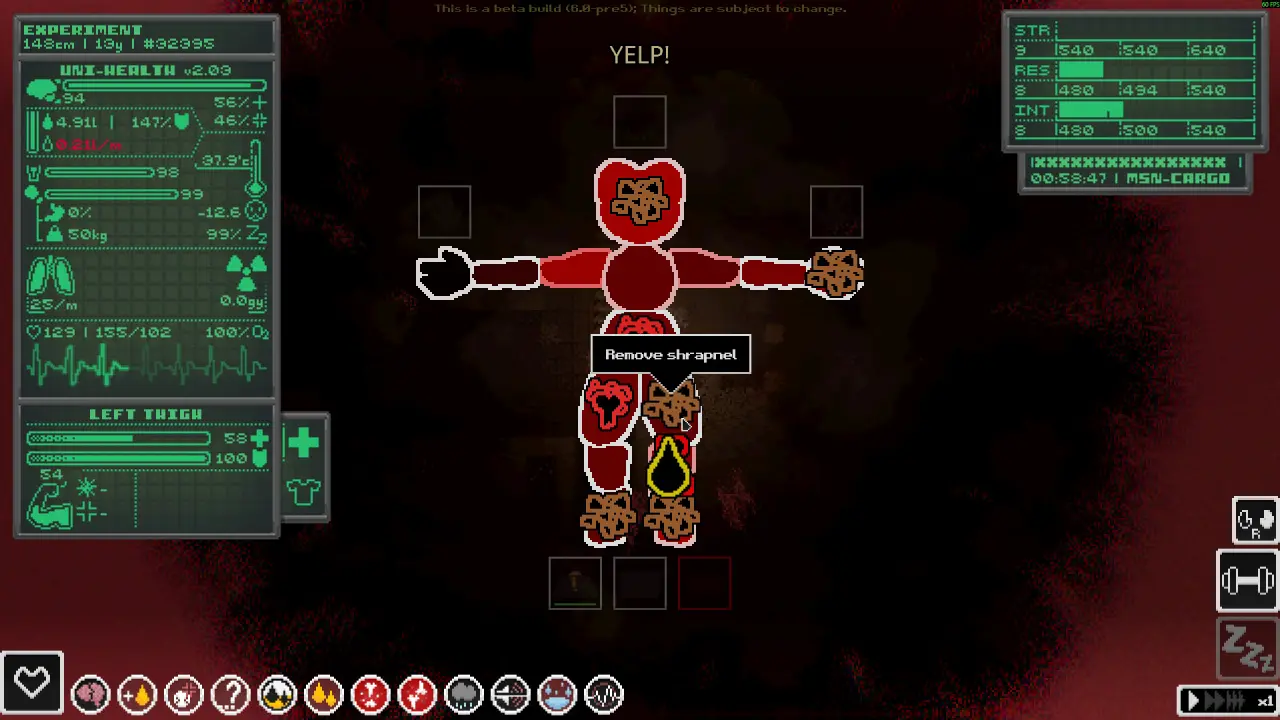
The panel is the in-game UNI-HEALTH chip. The body diagram shows icons on each limb: teardrops for bleeding (shown from about 0.018 L/min), cysts for infection (shown from 25%), a trembling joint for a dislocation, a broken bone for a fracture, and shards or rubble for shrapnel. A shaking limb is in pain.
The chip shows heart rate, blood pressure and oxygen saturation (SpO2) with an ECG trace, blood volume, and the total bleeding rate under it. Release 1.0 added an opiate and venom display to the panel. Moodles sit around the edge. Many items work by dragging them from your inventory onto a limb in the panel, which starts a minigame for dressings, shrapnel, dislocations, amputation and defibrillation.
In Unchipped runs most numbers disappear and you read symptoms instead: speech, posture, shaking, screen effects and your character's comments.
Pain, trauma and shock
Total pain is the pain of your worst limb. It rises from falls, hits, traps, using a broken limb, fixing dislocations, pulling shrapnel and some items such as alcohol.
| Moodle | Total pain | Effect |
|---|---|---|
| Discomfort | > 10 | No effect |
| Pain | > 30 | Red vignette, mood drops slowly |
| Severe pain | > 55 | Strong vignette, slower movement |
| Agony | > 80 | Near-blinding vignette, shock builds, ragdoll above 90 |
Above 50 pain you also build trauma, which leads to the Scared (25) and Traumatized (45) moodles. Pain shock above 66% knocks you out. Limb pain above 60% stops you fixing dislocations or pulling shrapnel on that limb.
Fix it: painkillers for small pain, morphine or fentanyl for big pain (watch the opiate overdose), and an ice pack, which speeds pain recovery by 150% and never runs out. Higher Resilience lowers pain overall: see skills.
Consciousness and passing out
Consciousness is capped by the worst of several things: oxygen, blood pressure, pain, brain health, energy, temperature, radiation and sickness. If you keep fainting, look at which of those is low.
| Moodle | Consciousness | Effect |
|---|---|---|
| Confused | < 90% | Mild blur, slightly slower |
| Very confused | < 72% | More blur and slowdown |
| Fainting | < 55% | Strong blur, darker view, much slower |
| Incapacitated | < 30% | Cannot act: no attacks, items, standing up or minigames |
| Unconscious | < 20% | Out cold; energy recovers |
| Concussed | head muscle < about 14% | Out until the head heals; head muscle heals 10x faster |
Common one-shot knockouts: a stalactite or skullcrusher to the head, a coil shock, a sound cannon blast, a bear trap on the head, and explosions. A helmet is the best prevention. See brain damage.
A medical kit worth carrying
From the community getting-started guide, a full mid-game kit covers each failure mode once:
- Sterilized dressing
- Tourniquet
- Blood bag
- Bruise kit
- Defibrillator (AED or manual)
- Auto-pump
- Epinephrine
- L.R.D. or makeshift L.R.D.
- Chest drain
- Antiseptic in a spray bottle
- Tweezers
- Wrench
- Ice pack
- Painkillers or morphine
Carry a wrench as well: batteries come out of devices with it, and a defibrillator without a charged battery is dead weight. Many crafted items need Intelligence first.
Version note. The September update and 1.0 made the game somewhat easier: some injuries are less debilitating, brain damage is less punishing and amputation is easier. Official
Questions
How do you heal in Casualties: Unknown?
There is no single heal button. Each injury has its own treatment: dressings for bleeding, an L.R.D. or procoagulant for internal bleeding, a chest drain for hemothorax, antiseptic for infection, a wrench for dislocations, a bone welding tool or splint for fractures, and defibrillators for the heart. Muscle and skin health also recover slowly while you eat well and sleep.
What do the colours of the moodles mean?
Moodles are the round status badges. The badge colour and the highlight show how severe the condition is, and critical moodles keep their highlight even while you are unconscious. Hover a moodle in the health panel to read its description.
Why is my character bleeding with no wound?
Blood volume falling with no teardrop icon on any limb usually means internal bleeding. Check the total blood-loss rate under the blood volume meter, then use an L.R.D., procoagulant or helluce.
What is the heal console command?
Type heal in the console (the ~ key). It resets your medical state but does not undo amputations, neural booster use or the Hollow state. Since 1.0, using it outside the tutorial sandbox disables achievements.
Sources
- Community wiki Injuries (limb and body statuses) Scav Prototype / C:U wiki, checked 2026-10-03
- Community wiki Blood (volume, pressure, internal bleeding, viscosity) Scav Prototype / C:U wiki, checked 2026-09-21
- Community wiki Heart rate, fibrillation and cardiac arrest Scav Prototype / C:U wiki, checked 2026-07-26
- Community wiki Consciousness Scav Prototype / C:U wiki, checked 2026-08-18
- Community wiki Infection and sepsis Scav Prototype / C:U wiki, checked 2026-10-03
- Community wiki Guide: Getting started Scav Prototype / C:U wiki, checked 2026-07-09
- Official Release 1.0 patch notes Steam news, checked 2026-11-09
- Official v6.0 patch notes Steam news, checked 2026-04-20